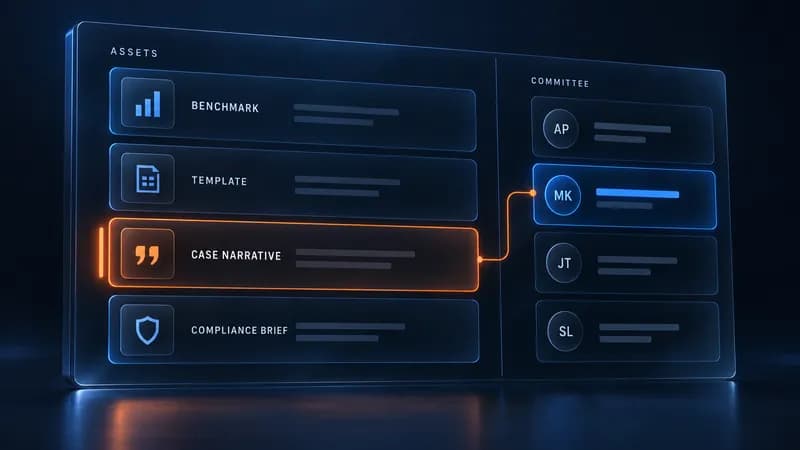
You have a tool you want to use on next month's campaign. Between you and the publish button sits a review gate, and nobody can tell you who owns it. The policy asks for a review and names no reviewer. Who do you ask?
It starts the same way every time. Someone finds a tool, tries it on one post, and it beats the process it replaced. Nobody objects, because nobody was asked. Six months later it runs on four surfaces, and the only record is a Slack thread nobody can find.
I have watched that cost a team a quarter. The tool was fine. The approval question arrived late, and a framework full of principles said nothing about who signs.
Six pages answering this query were read end to end for this piece. One carries a who-does-what table, two describe a committee in prose, and none publishes the chain as an object: which tier a use case falls into, what the decider must see, how long they have, and whose name sits on the correction.
That last item is the one nobody enjoys, and the only one that changes behavior. "Decision rights" is already standard vocabulary on this query. The artifact is not.
What an AI Governance Framework Actually Is
Google's AI Overview answers the definition at position one: the policies, processes and controls that govern how an organization builds and uses AI. Read it and you still will not know who signs.
Standard | Issued by | What it actually governs |
|---|---|---|
NIST AI RMF 1.0 | NIST, United States | risk identification, measurement and management across a system's life |
ISO/IEC 42001:2023 | ISO and IEC | a certifiable management system: objectives, roles, internal audit |
OECD AI Principles | OECD | values for member governments to legislate from |
UNESCO Recommendation on the Ethics of AI | UNESCO | commitments states adopt, addressed to public policy |
EU AI Act, as amended | European Union | obligations by risk class, with dates, penalties and a grace period |
One correction: plenty of pages still carry the old calendar. Regulation (EU) 2026/1744, in force from 27 July 2026, moved the Annex III high-risk obligations to 2 December 2027.
None of those five documents names a person inside your company. That is the work below. If you need the assessment side, our AI maturity model covers it, and this page does not.
The Three Approval Tiers Inside an AI Governance Framework

The failure mode has a name. Grant Thornton's 2026 AI Impact Survey of 950 C-suite and senior leaders summarises it: centralized review bodies get overwhelmed as use cases multiply, creating bottlenecks that slow the business without actually reducing risk.
The alternative is to sort by blast radius: how much damage a use case can do before anyone notices. Not by tool category, not by vendor. The same tool can sit in two tiers inside one company.
Two of the pages read for this piece carry a risk tier table from the EU AI Act and NIST. Those say how much control a system needs, not who grants it.
Tier | What lands here | Who decides | What they must see | Turnaround |
|---|---|---|---|---|
| a tool one person can switch off in an afternoon; output stays internal or is reviewed before it ships | the person who will use it, named in the register | one register row: surface, data touched, review date | same day, no meeting |
| output ships under the brand, touches customer data, or makes a claim that can cost money | one named owner in legal, security or data. A person, not a committee | the one-page packet | two working days. Silence is not a yes |
| regulated claims, a new customer segment, spend past a threshold you set, or a use case someone outside your team has already questioned | the standing review body, with a named chair and a written record | the packet plus a risk statement and a proposed review date | the next sitting, decision recorded and dated |
Four questions assign a tier. Can one person switch it off without asking anyone? Does the output reach a reader who does not work here? Does it touch customer data, or a claim a regulator could read? Has anyone outside your team already questioned it? One yes puts you at tier 2. Two or more, with the last a yes, means tier 3.
That table moves decisions down. Most marketing work sits at tier 1, and most teams route all of it through tier 3 because nobody drew the line.
The one-page packet
Five fields. Four are easy and the fifth is the one teams leave out.
- The use case in one sentence: what the tool does, for whom, on which surface.
- Where the output lands: an internal document, a page under your domain, a send to the list, a paid placement.
- The data that goes in, and the data that must not.
- One real sample output, not a vendor demo.
- The correction owner, meaning the name that appears when it goes wrong.
The packet is shorter than an assessment on purpose: a decider handed fourteen pages does not read them, so the answer becomes the cheap one. Our marketing measurement guide makes the same point from the reporting side.
The clock is what gives the chain authority
"We'll get back to you" is how a review gate loses its authority, and how teams learn to launch first and ask later. A queue without a deadline is a no with better manners. Two working days at tier 2 and the next sitting at tier 3 covers most marketing work.
The Use-Case Register Nobody Maintains

A register is one row per live use case, not per tool or per vendor. The row is what makes the chain auditable six months later, when the person who approved it has moved team and the tool has been renamed.
Use case | Surface | Tier | Owner | Review date |
|---|---|---|---|---|
Blog draft, first pass | WordPress draft | 1 | Campaign manager | 12 Feb 2027 |
Paid ad variants | live ad account | 2 | Legal owner | 3 Dec 2026 |
Launch page copy | product page under the domain | 2 | Product marketing lead | 15 Jan 2027 |
Customer email body | 40k subscriber list | 2 | Data owner | 3 Dec 2026 |
Regulated claim in a comparison table | published page | 3 | Review body chair | 2 Dec 2026 |
Owner means one name in that cell. A department cannot be accountable. An empty cell is not a tier; it is a queue nobody is running.
The failure mode is not a wrong row. It is a spreadsheet nobody opens: rows dated from launch week, departments in the owner column, a tool name where a use case belongs.
One rule saves an argument later. A row may move tier upward without a meeting, and only the decider may move it down. That asymmetry stops the most common drift: a tier 2 use case quietly reclassified as tier 1 by the person who wants to ship this week.
Our guide to the tools covers which products hold part of this in software, and our guide for marketing teams covers the marketing-specific layer. None decides for you, and a platform that promises to has sold you a committee with a license key.
The Gate Marketing Has and Engineering Doesn't: Published Output
An engineering team ships a system. A marketing team ships a claim, under the brand, on a page that gets indexed and quoted back at you in a sales call two years later. That is why the last gate is editorial.
The technical review asks whether the model is safe, the data lawful and the access controlled. The editorial gate asks whether a named editor signs, whether every number has a source, whether the voice rules hold, and whether a reader would feel misled.
Sourcing does most of the work. A model produces a plausible statistic in the exact shape of a real one, and the only defense is a person whose job is to open the source. No source, no claim.
A launch tests this hardest. A product page, a set of paid variants and an email go out the same morning carrying the same claims, each with its own owner. For the sequence itself, see our piece on product marketing strategy. The narrower question: one owner for the claims, or you fix the same sentence three times in a week.
Disclosure belongs in the same gate, and it has a commercial edge. In a Gartner survey of 1,539 US consumers in October 2025, 50% said they would rather give their business to brands that do not use generative AI in consumer-facing content. A first draft rarely needs a label; a synthetic image of a real person always does.
The rules, who may change the tone guide and which surface inherits which policy, live in our content governance guide. A rule set without a named signer is a document everyone agrees with and routes around anyway.
When an AI Output Ships and Is Wrong
Every framework is judged here, and most are silent. The question before launch is short: whose name goes on the correction?
Three decisions, together under a page. First, pull or patch. A live page with a false claim comes down or gets corrected the same business day. An ad variant gets paused rather than edited, because an edit needs the review the original had. An email cannot be recalled, so the correction goes to the same list.
Second, who decides, and how fast: the owner from the register row, or a named deputy, same business day for anything live. Third, what gets logged: what shipped, what was wrong, when it was noticed, who decided, what changed. Five fields, on one row, beside the approval.
I have watched a correction take four days because the only person who could approve the pull was away. That failure was installed months earlier, when nobody named a deputy. The correction itself took twenty minutes.
Most organizations still work this out afterwards. IBM's Cost of a Data Breach Report 2026 puts shadow AI in 43% of breached organizations, up from 20% a year earlier, and found 68% had no AI governance to manage it.
How the Chain Breaks in a 20-Person Team
Four shapes, and the size of the company decides which one you get.
No owner. The gate exists as a norm. Everyone knows a review is expected, nobody is named, so the answer is whatever the most senior person in the thread said. PagerDuty's 2026 Shadow AI Survey of 1,250 office professionals found two-thirds had used AI at work while believing it was not permitted.
Owner without authority. A coordinator who can ask questions but cannot stop a launch. McKinsey's State of AI survey puts direct AI governance ownership with the CEO in 28% of organizations and with the board in 17%. Grant Thornton found 46% of boards have not integrated AI risk into ongoing oversight.
Authority without evidence. A decider who says no to everything, because the packet is empty and the free answer is the safe one. Fix the packet, not the person.
Evidence nobody reads. A long assessment written once, filed, never opened. OneTrust's 2026 AI-Ready Governance Survey found 74% of organizations at scaled AI adoption and only 5% saying coordination and accountability are clear.
The minimum viable version for a team this size is three things: a register with three to eight rows, one named tier 2 owner outside marketing, and a review date on every row. No committee. Tier 3 should be empty most quarters; if it never is, your tier 1 is too narrow.
Schellman's 2026 State of AI Governance found 74% of 525 US professionals believe they could pass an AI compliance audit today, while 27% call their program fully mature. Confidence is not the signal. The register is.
Frequently Asked Questions
What is the difference between AI governance and AI compliance?
Compliance is an external standard you are measured against, with an auditor holding the ruler. Governance is the internal decision about who says yes, on what evidence, and how fast. An AI governance policy is the document; this chain applies it. A team can be compliant on paper and still not know who approved the tool running its ad account.
Do we need a separate AI agent governance framework?
Whether you write AI agent governance or AI agents governance, the answer is the same: the tier moves, the structure does not. An agent acts without a person in the loop, so the packet needs one more line about what it can reach.
Who should own AI governance in a marketing team?
Name one person for the register and let the decider change by tier. The register owner is usually whoever runs the content or campaign calendar, because use cases appear there first.
How often does the framework get reviewed?
Quarterly for the register as a whole, and on three triggers: a new tool, a new surface, and any correction. A review date per row beats an annual review of the document, because the document is not where the risk lives.

Put the chain where the work gets made
You can run this in a spreadsheet for a quarter and it will mostly work. Teams move it into the project where the work is produced for one reason: when a claim ships wrong, the approval, the sample output and the name already sit together.